The Pacific Northwest is two lawn regions that share a coastline. West of the Cascades the soil is acidic, the winter rain leaches nitrogen, and the lawn is perennial ryegrass with fine fescue. East of them the soil runs alkaline, the lawn is irrigated Kentucky bluegrass, and iron chlorosis is a way of life. The bag under new sod has to be right for both. West of the mountains that means taking the soil test seriously, because WSU's own bulletin says phosphorus and potassium deficiencies are common there; east of them it means keeping iron out of the soil, where it is useless, and putting it on the leaf, where it works. This page is what Washington State, Oregon State, and the University of Idaho say goes under sod, the one state law that applies, and the bag we built to that spec, with the source for every claim.
Quick answer
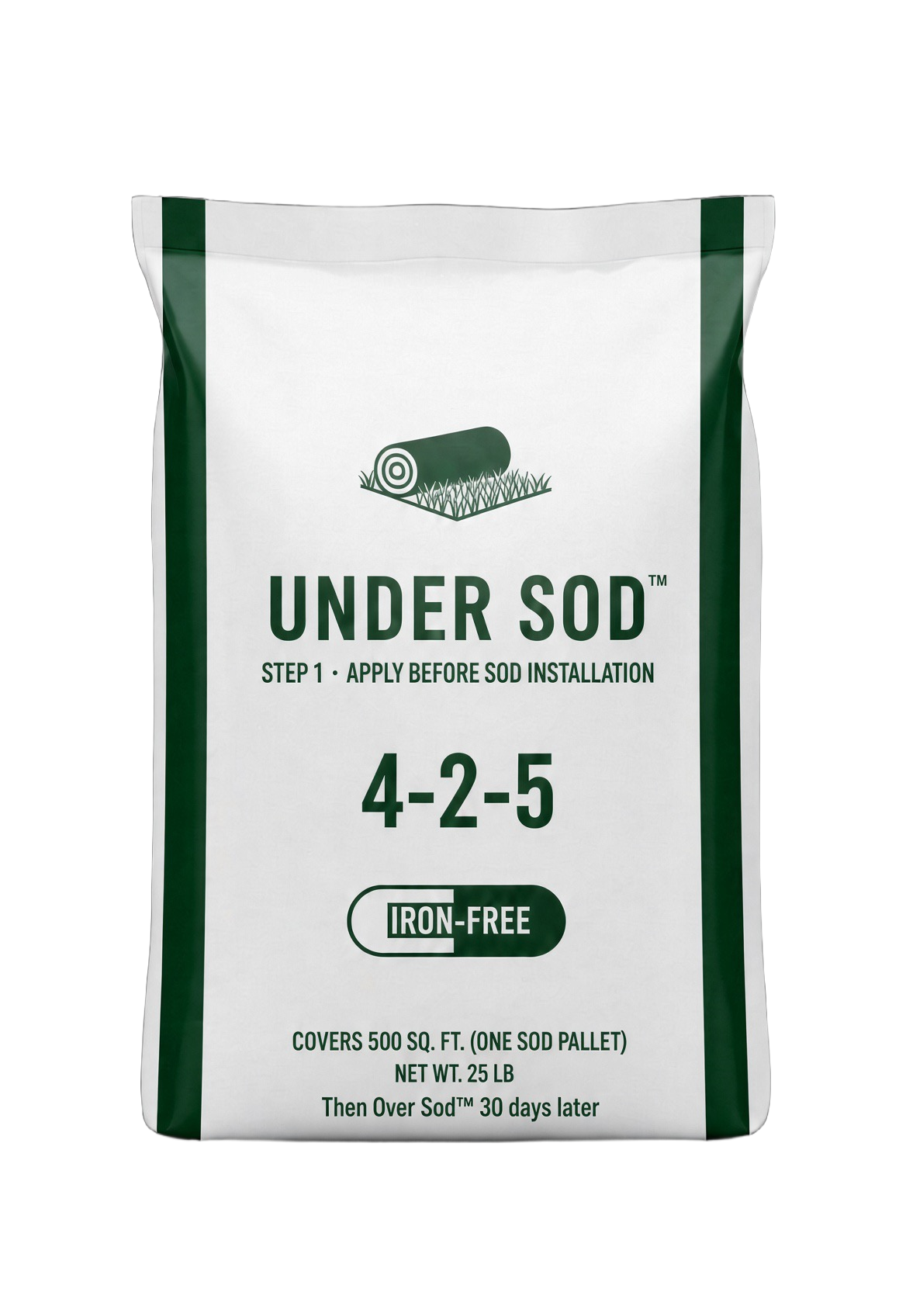
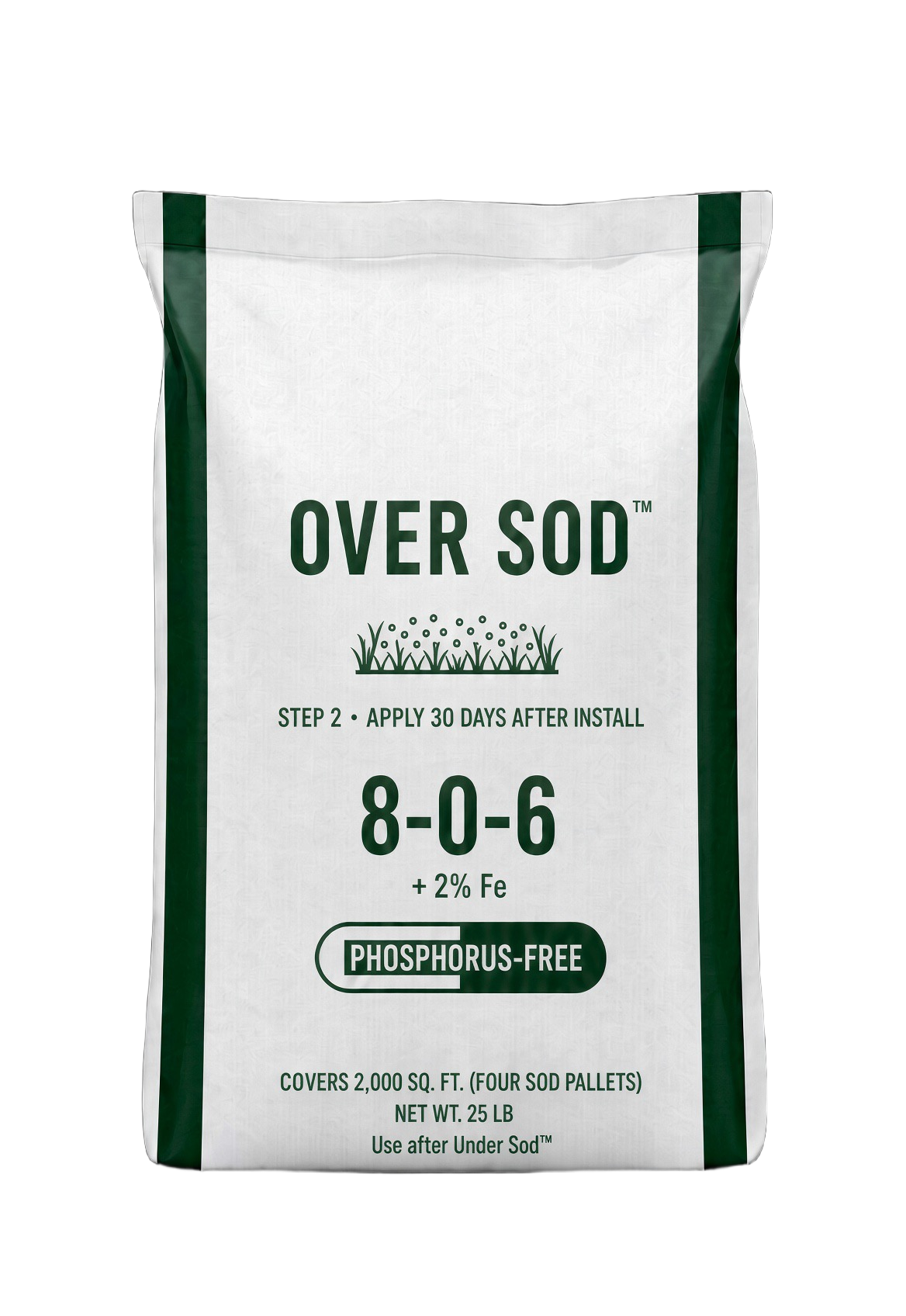
Test the soil. West of the Cascades, expect to lime, and expect the test to come back low in phosphorus or potassium more often than it does in the Northeast or Midwest; east of them, expect a high pH and skip anything that promises iron in the soil. If phosphorus comes back at or above WSU's thresholds, 25 ppm Bray west or 18 ppm Olsen east, skip the starter and mix a low-phosphorus, potassium-forward bag with living biology into the top 4 to 6 inches once, before the sod goes down. Below the threshold, a starter at the report's rate, mixed in the same way. Nothing on top for 30 days. The 4-2-5 with no iron and four species of mycorrhizae, one 25-pound bag per pallet mixed into the top 4 to 6 inches, is UNDER SOD™; the 8-0-6 with 2 percent non-staining iron, one 25-pound bag per four pallets at 30 days, is OVER SOD™. Both are planned for spring 2027 and are not on any shelf yet.
Two regions, one test
| Factor | West of the Cascades (Puget Sound, Willamette Valley, coast) | East of the Cascades (Spokane, Yakima, Boise, Bend) | Source |
|---|---|---|---|
| Soil pH | Acidic, most soils pH 5 to 6.5; lime is the common correction, dolomitic where magnesium is short | Neutral to alkaline; high-pH soils lock up iron | WSU Skagit County; OSU; University of Idaho |
| Nitrogen | Winter rain leaches it; nitrogen deficiency is the most common deficiency in western Washington lawns | Irrigated lawns need 3 to 5 lb N per year in southern Idaho | WSU Master Gardeners; University of Idaho CIS 846 |
| Phosphorus | Deficiencies of phosphorus and potassium are common in western Washington (WSU Home Lawns); adequate above 25 ppm Bray P1, and lawns with a fertilizer history often need little or none (WSU FS058E). The test decides. | Eastern Washington lawns usually need only nitrogen (WSU Home Lawns); adequate above 18 ppm Olsen | WSU EB0482E; WSU FS058E |
| Potassium | Use potassium at percentages similar to nitrogen unless a test shows it very abundant; it drives heat, drought, wear, and winter tolerance | University of Idaho | |
| Iron | Rarely the problem | Often the problem; soil-applied iron becomes unavailable quickly on high-pH ground, only chelates work in soil, and sulfate forms work on the leaf | University of Idaho |
| The grass | Perennial ryegrass with fine fescue; ryegrass is the most widely planted grass in much of Oregon | Kentucky bluegrass with perennial ryegrass | OSU EC 1278; OSU Kowalewski |
| The law | Washington restricts phosphorus turf fertilizer except to establish or repair grass, or on a 36-month soil test; Oregon and Idaho have no statewide lawn phosphorus law we found | WSDA; WSU FS058E | |
The phosphorus threshold WSU already published
Washington State University's fact sheet on phosphorus and home lawns, written for the 2013 law, prints the number most fertilizer aisles leave out: the minimum adequate soil phosphorus for turfgrass is 25 ppm by Bray P1 in western Washington and 18 ppm by Olsen in eastern Washington, and above those levels "it is unlikely your lawn will benefit from fertilizer P." It says where phosphorus is needed, apply "1/8 lb. to 1 lb. of P2O5" based on the test. And it says the thing about sod that seed-based advice never does: "Since lawn sod is often fertilized with phosphorus during production, newly sodded lawns may require less P fertilizer than newly seeded turf."
That last sentence is the whole case against the 24-25-4 bag under a roll of sod. The sod farm fed the phosphorus. The plant arrives with tissue reserves. What it needs in your soil is potassium for the new roots, water, contact, and the biology that extends those roots, and it needs the phosphorus in the contact zone kept low enough that it will accept the biology. On a scraped new-construction lot, or a sandy site that tests below the threshold, the starter is right and the calculation flips; the test decides.
West of the Cascades the test flips more often than it does elsewhere, and WSU says so in its Home Lawns bulletin: "In Western Washington, deficiencies of phosphorus and potassium are common; therefore, fertilizers with a 3-1-2 or 6-1-4 ratio of N-P-K usually give best results," while "Eastern Washington lawns need only nitrogen" in general. Read those two WSU sheets together and the western rule is: test, and if phosphorus is below 25 ppm Bray, add phosphate at the report's rate. What WSU's ratio does not do is call for a 24-25-4. A 6-1-4 puts more potassium than phosphorus in the bag, which is the shape of the under-sod bag below, and the planned 4-2-5 at one bag per pallet delivers 1 pound of P2O5 per 1,000 square feet, the top of WSU's own 1/8-to-1-pound range, before any starter is added.
Where phosphorus is restricted without a test
| State | On new sod | On an established lawn | Other limits | Source |
|---|---|---|---|---|
| Washington | Allowed to establish grass by seed or sod, and to repair it during the growing season in which it was established | Only with a soil test within the previous 36 months showing deficiency; retail sale and display of phosphorus turf fertilizer are restricted unless the label is for a permitted use | Not on frozen ground; not on impervious surfaces; fertilizer that lands on pavement must be cleaned up | WSDA, Restrictions on Turf Fertilizers Containing Phosphorus; WSU FS058E |
| Oregon | No statewide lawn phosphorus law found in the Revised Statutes or on OSU Extension's pages (September 2026); OSU's guidance is the same in practice: test, lime per the report, apply nutrients the test calls for | OSU EC 1278; OSU Extension | ||
| Idaho | No statewide lawn phosphorus law found; University of Idaho guidance: phosphorus matters during establishment, mature lawns mine it well, use low-phosphorus fertilizers unless very deficient | University of Idaho, Fertilizing Lawns | ||
Washington's law is the model for the region even where it does not apply. It exempts establishment because the legislators understood the seedling problem, and it restricts the same bag on the same lawn a year later. That is the reason the label says "under, once."
What the universities say goes under sod
Three things, in every land-grant sheet: it follows the test, it goes into the soil, and it goes in once. The University of Idaho's southern Idaho lawn guide gives the regional reason for the second: "Phosphorus may also encourage weed growth (dandelions) if applied to the surface of the grass or soil." Penn State's establishment report says to "thoroughly mix recommended phosphate (P2O5) and/or potash (K2O) into a four to six inch soil depth." Michigan State's sodding bulletin puts it in the top 4 inches. Surface starter under sod feeds the seam and the dandelions; incorporated fertilizer feeds the roots.
On potassium the University of Idaho is unusually direct: "Unless a soil test reveals that potassium is very abundant, fertilizers with percentages of potassium similar to nitrogen should be used," because potassium "helps grasses respond to heat and drought stress" and "promotes winter hardiness." A 24-25-4 starter delivers 0.12 pounds of K2O for every 0.72 of nitrogen. A 4-2-5 delivers 2.5 for every 2.
On lime, west of the mountains: OSU's rule of thumb is that "Western Oregon soil is acidic and the winter rains deplete nitrogen levels," and WSU's Skagit County Master Gardeners put most western Washington soils at pH 5 to 6.5, recommending dolomitic lime where magnesium is short. Lime goes in with the fertilizer, before the sod, at the report's rate, not by habit.
Why phosphorus and root fungi pull in opposite directions
Cool-season turf roots are colonized by arbuscular mycorrhizal fungi that extend the root's reach for water and phosphorus. The plant stops paying for the partnership when phosphorus is easy: Treseder's 2004 meta-analysis of field studies found mycorrhizal abundance fell 32 percent on average under phosphorus fertilization. The University of Minnesota's turfgrass program reviewed the turf literature and lists Kentucky bluegrass, the fescues, perennial ryegrass, and creeping bentgrass among grasses that form the association, citing Pelletier and Dionne's 2004 finding of faster establishment of Kentucky bluegrass, red fescue, and perennial ryegrass with Glomus intraradices. That species, now named Rhizophagus irregularis, is one of the four on the planned UNDER SOD™ label. The mechanism is the reason the label reads 4-2-5 and not 12-18-8: enough phosphorus to matter on an optimum soil, not enough to tell the plant to decline the fungi.
Iron, east of the Cascades, and why the under-sod bag has none
The University of Idaho's lawn page reads like it was written for this bag: "The high pH soils of southern Idaho tie up iron making it unavailable to the plant causing it to become yellow (iron chlorosis)... Iron in the forms of ferrous sulfate or iron sulfate are absorbed by the leaves. If washed into the soil, the iron quickly changes form and becomes unavailable to the plant." Iron tilled 4 inches deep under sod on a pH 7.8 soil is unavailable before the sod is rolled; on the acidic soils west of the mountains it is rarely the problem in the first place. Either way it does nothing for the roots, which is the only job under the sod. Iron belongs on the leaf, at day 30, in a non-staining form, after the roots have taken. That is where OVER SOD™ carries its 2 percent.
The rubric, and how the bags on a Northwest shelf score
| Requirement | Source | UNDER SOD™ (planned) | Suståne BOLSTER 4-4-4 | 10-10-10 (no-test default) | Scotts Starter 24-25-4 |
|---|---|---|---|---|---|
| 1. Phosphate at or under about 1 lb P2O5 per 1,000, once, in the soil | WSU FS058E; Cornell | Pass, 1.0 | Pass at the loam rate; doubles at the sand rate | Pass, 1.0 | Fail on surface, and the label repeats it |
| 2. K2O at or above N | University of Idaho | Pass, 2.5 vs 2.0 | Pass, 4-4-4 | Pass | Fail, 0.12 vs 0.72 |
| 3. N at or under 2 lb, mostly slow-release | OSU EC 1278; Cornell CCE | Pass on the target; slow-release share to be labeled | Pass | Pass on the rate; soluble | Pass on the rate; mostly soluble |
| 4. Labeled to incorporate, with a depth | Penn State; MSU; Idaho on surface P | Pass, 4–6 in | Pass, preplant incorporate | Pass, as the labs use it | Fail, surface |
| 5. Living biology in the contact zone | Pelletier & Dionne 2004; UMN review | Pass, four AMF species plus Bacillus and Trichoderma | Pass, four Glomus species | Fail | Fail |
| 6. No iron under the sod | University of Idaho; K-State | Pass | Fail, 3% iron | Pass | Pass |
| 7. Sod rate printed on the bag | Field requirement | Pass, one bag per pallet | Pass | Fail | Fail |
| Score | 7 of 7, planned label | 5 pass, 1 close, 1 fail | 4 of 7 | 2 of 7 |
Suståne BOLSTER 4-4-4 is the closest bag on a shelf today and scores 5 of 7 because it carries 3 percent iron under the sod and its phosphate doubles at the sand rate; east of the Cascades that iron is locked up on contact, and west of them it is not the problem. The 10-10-10 is the no-test default the Michigan bulletin uses, with no biology and no sod rate. The Scotts starter is what the shelf pushes; it was built for seed on a low-phosphorus seedbed, it is potassium-light by Idaho's standard, and its label tells you to repeat it in two to four weeks, which is the wrong thing to do to sod.
Timing in a place where the ground rarely freezes west and freezes hard east
West of the Cascades, sod can go down most of the year on unfrozen ground, and the rain does the watering from October to May. OSU's fertilizing guide assumes 1 pound of nitrogen per application and warns against early-spring feeding because the grass "normally grows vigorously by itself at that time." WSU's Home Lawns bulletin puts Washington lawns at 4 pounds of nitrogen a year in four applications, with the western Washington late-fall application between November 15 and December 7 and no early-spring feeding before April 1; WSU's King County Master Gardeners add that a slow-release synthetic can go on as late as mid-November, and WSU's Walla Walla office says that if you fertilize once a year, fall is the time. For new sod that means the 30-day feeding goes on at day 30 if the grass is growing, and the spring program starts later than instinct says. East of the Cascades the calendar is a Midwest calendar: fall is the window, the ground freezes, and sod laid after top growth stops roots a little, goes dormant, and finishes in April. Whatever went under the sod is the whole first-month program either way.
The procedure
- Test the soil before the sod is ordered: 10 to 20 cores, top 3 to 4 inches, Bray P1 west of the Cascades or Olsen east, turf recommendation. On new construction, test the placed topsoil.
- Read the phosphorus line against WSU's thresholds: 25 ppm Bray west, 18 ppm Olsen east.
- Lime per the report west of the mountains, dolomitic where magnesium is short; sulfur per the report if pH runs high east of them. Incorporated with the fertilizer.
- At or above threshold: one 25-pound bag of UNDER SOD™ per 500-square-foot pallet, tilled or harrowed into the top 4 to 6 inches, once. Below: a starter or straight phosphate at the report's rate the same way, and count UNDER SOD™'s 1 pound of P2O5 toward it.
- Finish grade. Lay the sod the day it arrives. Roll. Water.
- Nothing on top for 30 days. Water every day for two weeks, rain or not.
- Day 30, tug test, then one 25-pound bag of OVER SOD™ per four pallets on growing grass. Iron for color goes here and nowhere else.
- Resume the normal program for your grass and your side of the mountains.
Where to get it in the Northwest
Nowhere yet. UNDER SOD™ and OVER SOD™ are planned for spring 2027 and are not at SiteOne, Home Depot, Lowe's, or garden centers. If you want a bag when they ship, join the list. The two-step system and the planned labels are on Built to Spec and the OVER SOD™ page; the full nine-bag scoring is on the Honest Comparison.
What we are not claiming
UNDER SOD™ and OVER SOD™ are planned labels; the water-insoluble nitrogen share, salt index, and organism counts will be printed on the bag when they are locked. There is no independent multi-site sod trial of either bag, and no Northwest trial at all. Oregon and Idaho are listed as having no statewide law because we found none, not because a state confirmed it. WSU's phosphorus thresholds are for Washington soils; Oregon and Idaho labs may use different extractants and categories, and the report's category governs. Western Washington's pH figures come from a county Master Gardener sheet, not a statewide survey. Two WSU publications pull in different directions on western Washington phosphorus, the Home Lawns bulletin calling deficiencies common and the phosphorus fact sheet setting a threshold above which fertilizer P is unlikely to help; we quote both, and the soil test is how you find out which one describes your lawn.
Sources
- Washington State University Extension, FS058E, Phosphorus and Home Lawns: Quick Facts and Recommendations (Stahnke). Thresholds of 25 ppm Bray P1 west and 18 ppm Olsen east; 1/8 to 1 lb P2O5 by test; newly sodded lawns may require less phosphorus than seeded turf. wpcdn.web.wsu.edu/…/product-3984-sku-FS058E.pdf
- Washington State Department of Agriculture, Restrictions on Turf Fertilizers Containing Phosphorus (ESHB 1489, 2011). agr.wa.gov/…/Fertilizers-Containing-Phosphorus
- WSU Extension, Skagit County Master Gardeners, Ask the Master Gardener: soil pH (2007). Most western Washington soils pH 5 to 6.5; dolomitic lime where magnesium is deficient. wpcdn.web.wsu.edu/extension/…/040107.pdf
- Washington State University Extension, EB0482E, Home Lawns. Fertilizer by soil test; western Washington phosphorus and potassium deficiencies common, 3-1-2 or 6-1-4 ratios; eastern Washington nitrogen only; 4 lb N per year in four applications, late fall November 15 to December 7, no early spring before April 1. pubs.extension.wsu.edu/home-lawns (quoted via the WSU Master Gardener column in The Columbian, October 2013: columbian.com/news/2013/oct/02/10-03-garden-expert)
- WSU Extension Master Gardener Program, King County, Tip Sheet 11: Lawns (February 2025). Fertilize mid-May if needed at 1/2 to 1 lb N; slow-release synthetic as late as mid-November; lime if needed; new lawns before Memorial Day or after Labor Day. wpcdn.web.wsu.edu/…/MG-TS11-Lawns_Feb-2025.pdf
- WSU Extension, Walla Walla County, Lawn Care. 3:1:2 ratio with some slow-release nitrogen; fall the most important application. extension.wsu.edu/wallawalla (Lawn Care)
- Oregon State University Extension, EC 1278, Fertilizing Lawns (Cook and McDonald). Perennial ryegrass the most widely planted grass in much of Oregon; 1 lb N per application; avoid early-spring applications. extension.oregonstate.edu/…/EC1278.pdf
- Oregon State University Extension, Choose the right grass for your Oregon lawn (Kowalewski). Regional mixtures. extension.oregonstate.edu/news/choose-right-grass-your-oregon-lawn
- Oregon State University Extension, Ask Extension. Western Oregon soil is acidic; winter rains deplete nitrogen; lime often recommended for lawns. ask2.extension.org/kb/faq.php?id=891503
- Oregon State University Extension, EM 9086, Nutrient Management of Perennial Ryegrass Grown for Seed in Western Oregon. The Northwest produces about 85 percent of U.S. perennial ryegrass seed. extension.oregonstate.edu/…/em-9086
- University of Idaho Extension, Fertilizing Lawns. Phosphorus during establishment; potassium similar to nitrogen; iron on high-pH soils, sulfate on the leaf, chelates in the soil. uidaho.edu/extension/landscapes/lawn/fertilize
- University of Idaho Extension, CIS 846, Southern Idaho Lawns (Mahler, Falen, Bell). 3 to 5 lb N per year; surface phosphorus may encourage dandelions; iron often required. uidaho.edu/…/cis0846.pdf
- Penn State Agricultural Analytical Services Laboratory, sample soil test report for a home lawn to plant. Incorporate 4 to 6 inches; starter definition. agsci.psu.edu/aasl/…/sample-soil-test-report-for-home-lawn-to-plant
- Michigan State University Extension, E2911, Nine Steps for Establishing a New Lawn Using Sod. Incorporation depth; no-test 10-10-10. sanweb.lib.msu.edu/…/E2911-2004.PDF
- Kansas State Research and Extension, MF2311. Excess phosphorus and iron uptake; potassium and stress tolerance. bookstore.ksre.ksu.edu/pubs/MF2311.pdf
- Cornell Turfgrass Program, Lawn Care: Feeding. "Only if P is low should a fertilizer with P be used"; 1 lb N per application ceiling. turf.cals.cornell.edu/lawn/…/feeding
- University of Minnesota Turfgrass Science, Sessoms 2020. AMF and their interactions with turfgrass species. turf.umn.edu/news/arbuscular-mycorrhizal-fungi-amf…
- Treseder, K. K. 2004. A meta-analysis of mycorrhizal responses to nitrogen, phosphorus, and atmospheric CO2 in field studies. New Phytologist 164:347–355. doi.org/10.1111/j.1469-8137.2004.01159.x
Questions
Do I need a starter fertilizer under sod in Washington, Oregon, or Idaho?
Only if a soil test says phosphorus is low, which happens more often west of the Cascades than in most of the country: WSU's Home Lawns bulletin says phosphorus and potassium deficiencies are common in western Washington. WSU's threshold is 25 ppm Bray P1 west of the Cascades and 18 ppm Olsen east of them; above those, the lawn is unlikely to benefit from phosphorus fertilizer. WSU also notes that newly sodded lawns may need less phosphorus than seeded turf because sod is fertilized with phosphorus while it is grown. On a low test, or on scraped new-construction fill, a starter at the report's rate mixed into the top 4 to 6 inches is right and, in Washington, legal for new turf.
Is phosphorus fertilizer legal on new sod in Washington?
Yes. Washington's Water Quality–Fertilizer Restrictions law, effective 2013, allows phosphorus turf fertilizer to establish grass by seed or sod and to repair it during the season it was established, or where a soil test within 36 months shows a deficiency. On an established lawn without a test, phosphorus turf fertilizer may not be applied or sold at retail. Oregon and Idaho have no statewide lawn phosphorus law that we found.
What NPK should go under new sod in the Pacific Northwest?
On an optimum or high phosphorus test, a low-phosphorus, potassium-forward analysis mixed into the top 4 to 6 inches once. The University of Idaho's lawn guidance is to use potassium at percentages similar to nitrogen unless a test shows potassium is very abundant. The planned UNDER SOD™ label is 4-2-5: one 25-pound bag per 500-square-foot pallet delivers 2 pounds of nitrogen, 1 pound of P2O5, and 2.5 pounds of K2O per 1,000 square feet through the rooting profile.
Why should fertilizer under sod be mixed in rather than spread on the surface?
Because phosphorus does not move in soil and, on the surface, it feeds weeds instead of roots: the University of Idaho's southern Idaho lawn guide says phosphorus applied to the surface may encourage dandelions. Penn State's establishment reports say to mix phosphate and potash into a 4 to 6 inch depth; Michigan State's sodding bulletin says the top 4 inches.
Should the bag under sod have iron east of the Cascades?
No. The University of Idaho explains why: on the high-pH soils of southern Idaho, iron washed into the soil quickly changes form and becomes unavailable, so iron sulfate only works when absorbed by the leaves and only chelates work soil-applied. Iron in a bag tilled 4 inches deep under sod is locked up before the sod is rolled. Iron belongs on the leaf at the 30-day feeding, in a non-staining form, which is where OVER SOD™ carries it.
Do western Washington and Oregon lawns need lime before sod?
Often. Most western Washington soils sit between pH 5 and 6.5, and OSU says western Oregon soil is acidic and winter rains deplete nitrogen. Test first: WSU's turf guidance is that lime matters when pH is below the 5.5 to 7 range turf prefers, and that soils west of the Cascades are often low in calcium and magnesium, which is where dolomitic lime comes in. Incorporate lime with the fertilizer before the sod, at the report's rate.
When do I fertilize new sod after laying it in the Northwest?
Thirty days after installation, after it passes the tug test, with a phosphorus-free bag at about 1 pound of nitrogen per 1,000 square feet. OSU's lawn fertilizing guide assumes 1 pound of nitrogen per application and advises against early-spring feeding of established lawns; WSU splits the year between May and September. The 8-0-6 with 2 percent non-staining iron, one 25-pound bag per four pallets at 30 days, is OVER SOD™, planned for spring 2027.
What grass is Northwest sod?
West of the Cascades, mostly perennial ryegrass with fine fescue; OSU calls perennial ryegrass the most widely planted grass in much of Oregon, and western Oregon grows about 85 percent of the country's perennial ryegrass seed. Central and eastern Oregon, eastern Washington, and Idaho lean on Kentucky bluegrass with perennial ryegrass. All are cool-season grasses, and all form the mycorrhizal associations the under-sod bag is built to feed.
Where can I buy UNDER SOD™ in the Northwest?
Nowhere yet. UNDER SOD™ and OVER SOD™ are planned for spring 2027 and are not at SiteOne, Home Depot, or garden centers. Join the list on this site to be notified when they ship.
Which lab should I use for a lawn soil test in the Pacific Northwest?
Washington: WSU Extension does not run a public soil lab; use a commercial lab your county extension office lists, and ask for a turf recommendation using Bray P1 west of the Cascades or Olsen east of them. Oregon: OSU's Central Analytical Laboratory or a commercial lab, read against OSU's Soil Test Interpretation Guide. Idaho: the University of Idaho's Analytical Sciences Laboratory or a commercial lab. Sample 10 to 20 cores from the top 3 to 4 inches.