What to Put Under New Sod: The Soil Science of Root Establishment
The short version
When sod is harvested, the deeper part of its root system is cut away, and it has to rebuild roots into new soil — fast. The single biggest lever on how well that happens is the prepared soil beneath the sod, not what's applied on top afterward. Decades of soil-biology research point to a counterintuitive conclusion: the high-phosphorus "starter" fertilizers conventionally recommended for new lawns can actually suppress the mycorrhizal root partnerships that help new turf establish deep, self-sufficient roots. UNDER SOD™ is built around that research — a low-phosphorus, K-forward 4-2-5 paired with named endomycorrhizae, a *Bacillus* PGPR consortium, *Trichoderma*, Ascophyllum nodosum seaweed extract, and humic and fulvic acid (and iron-free by design), applied to prepared soil before the sod goes down, at one 25 lb bag per 500 sq ft (about one pallet). This article walks through the science, including its honest limits.
The Question Nobody Could Answer Well
For years, across thousands of sod orders, the most common question CT Sod heard was simple: "What fertilizer do I use for new sod?" And there was never a clean answer — because the honest answer cuts against decades of retail-shelf convention.
This article is the long-form version of that answer. It's written to be useful whether you ever buy a bag of anything: it explains what actually happens when sod is installed, what the soil-biology research says about supporting root establishment, where that research is solid and where it's still uncertain, and how those findings shaped a product designed to go beneath new sod rather than on top of it.
We'll cite the research throughout — peer-reviewed studies and university extension guidance — and we'll flag the places where the science is genuinely mixed. A page that overstates its case doesn't deserve to be trusted, and we'd rather be the resource that gets the nuance right.
Part 1: What Actually Happens When Sod Is Installed
A pallet of sod looks like a finished lawn. Biologically, it's a plant in the middle of a serious transplant.
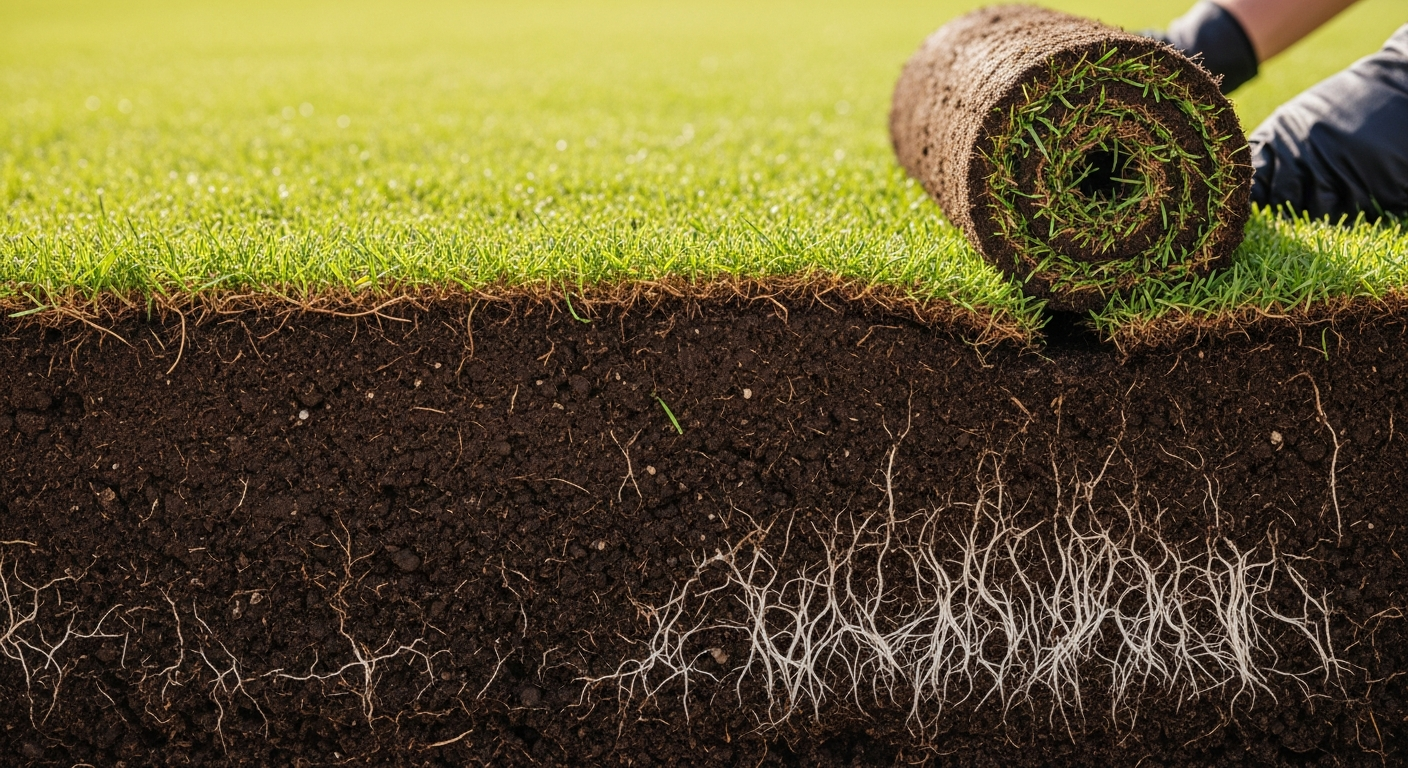
Sod is mature, living turf grown on a farm and then cut from the field, typically with only about a half-inch to an inch of soil and roots attached. That cut leaves the crown and the shallow root mass intact but severs the deeper root system the plant had developed in the field. The turf is then rolled, stacked, shipped, and laid onto soil it has never grown in. From the moment it's cut, it is running on stored energy and moisture, and it has one urgent job: push new roots into the new soil and knit down before it runs out.
University extension guidance and field experience converge on the timeline:
- Initial root contact with the underlying soil generally forms within about 7–14 days.
- Active root extension continues through roughly the first 4–8 weeks.
- Full establishment — when the lawn functions as one integrated root system rather than a mat of cut sod — typically takes 6–9 months for a spring installation, reaching mature performance the following year (CT Sod, How New Sod Roots: 12-Month Timeline). We break this window down in How New Sod Roots.
During that first window the plant is under transplant stress and is vulnerable to dehydration, heat, and uneven rooting. Two things determine whether it comes through cleanly, and neither is the grass itself:
- The soil it's rooting into — a real, prepared topsoil layer the new roots can penetrate, not compacted subsoil, builder's fill, or rock.
- Soil-to-sod contact and moisture during establishment.
Rutgers is direct about the first point: sodding produces a lawn in hours, but proper soil preparation before placement is essential for turf survival, and sod laid on compacted or carelessly prepared soil will not perform (Rutgers NJAES, Sodding: Steps to an Instant Lawn, FS104). CT Sod's own installation guidance calls for several inches of quality topsoil — generally a 4-inch minimum — over a loosened, smooth-graded base (CT Sod). For the full walkthrough, see How to Install New Sod the Right Way.
The takeaway that drives everything below
The root zone underneath is the limiting factor in sod establishment. So the highest-leverage moment to influence a new lawn is before the sod is ever laid — when you still have access to that soil.
Part 2: Why "Feed the Grass on Top" Is the Wrong Model for New Sod
The instinct with a new lawn is to feed it — to broadcast a fertilizer over the fresh sod to "get it going." The research says that's both unnecessary and, done wrong, counterproductive.
UF/IFAS found that the risk of nutrient leaching is much greater on newly planted sod than on established turf, because new sod has a shallow root system and already carries fertilizer imported from the sod farm. Their guidance is to wait 30 to 60 days after planting before applying nitrogen to new turf (UF/IFAS, Homeowner Best Management Practices, EP236). Rutgers similarly notes that a newly sodded lawn already carries enough nutrients for at least the first several weeks, and that you should feed based on a soil test only once color and growth begin to decline — and not over-fertilize (Rutgers FS104).
In other words, dumping fertilizer on top of brand-new sod largely runs off or leaches, and it isn't where the plant's bottleneck is. The bottleneck is at the soil-to-root interface underneath, during the weeks the plant is rebuilding roots. That's the leverage point — and it's only reachable before installation.
This is the entire logic of putting a starter under the sod rather than on it — and the practical how-to lives in What to Put Under Sod.
Part 3: The Conventional High-Phosphorus Starter Problem
For decades, the standard recommendation for new lawns has been a high-phosphorus "starter fertilizer" — formulations like 18-24-12 or 12-25-12, where the middle number (phosphate) is high. The reasoning came from a "feed the plant" framework: phosphorus supports root and early growth, so load the soil with it and the plant takes it up.
That framework isn't wrong, exactly — phosphorus is essential for root energy metabolism (it's in ATP and in every cell membrane). But it's incomplete, because it treats the soil as an inert delivery medium and ignores the biology that actually builds a self-sufficient root system. And as the next section shows, a flood of available phosphorus has a specific, well-documented side effect: it switches off the mycorrhizal symbiosis that new roots would otherwise form. For the practical version of this argument, see Best Fertilizer for New Sod.
Part 4: The Core Science — High Soil Phosphorus Suppresses Mycorrhizal Symbiosis
This is the central, and most counterintuitive, finding behind UNDER SOD™. It is also one of the better-established results in plant–soil biology.
What mycorrhizae are
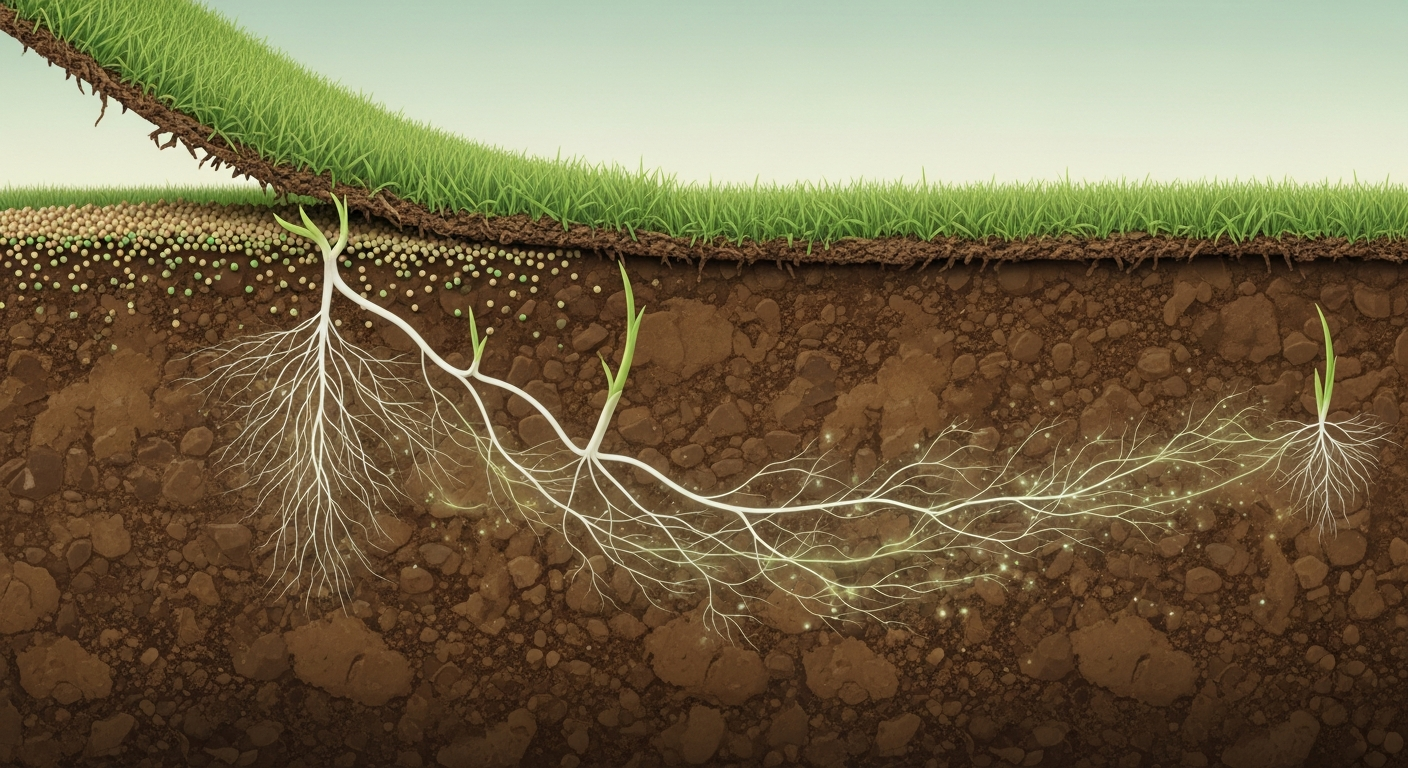
Roughly 80% of land plant species form a symbiosis with arbuscular mycorrhizal (AM) fungi — an ancient partnership, around 450 million years old, thought to have helped plants colonize land in the first place (Nouri et al., 2014; Breuillin-Sessoms et al., 2013). The fungus colonizes the plant's roots and extends a network of microscopic filaments (hyphae) out into the soil. Because hyphae are far thinner than roots, they reach into pores and soil volumes roots can't physically access, and they explore soil well beyond the zone roots have already depleted (Nouri et al., 2014). Through that network the plant takes up more phosphorus and water than its roots could alone, and the association is also linked to improved drought resistance, resistance to soil-borne pathogens, and better soil structure (P-gradient study, 2013).
Turfgrasses are part of this club. Perennial ryegrass, for example, is a documented AM host, and its carbon trade with AM fungi has been measured directly (cited in Springer, 2020). We go deeper on this partnership in Mycorrhizal Fungi and New Sod Rooting.
The trade — and why high phosphorus breaks it
The symbiosis is an economy. The plant pays the fungus in carbon (sugars from photosynthesis — by some measures up to ~20% of the plant's photosynthetic carbon can flow to AM fungi) in exchange for phosphorus and water the fungal network gathers (Breuillin-Sessoms et al., 2013).
Here's the key: when the soil is already saturated with available phosphorus, the plant can take up all the P it needs directly through its own roots — so it stops "paying" for the fungal service. Colonization is downregulated, and at high soil-P levels it can be strongly suppressed or even eliminated. Researchers have documented this repeatedly:
- High phosphate availability inhibits the establishment and persistence of the symbiosis and shifts the plant toward direct, non-symbiotic phosphorus uptake (Breuillin-Sessoms et al., 2013).
- Elevated phosphorus supply exerts strong inhibition of arbuscular mycorrhizal development (Nouri et al., 2014).
- Across a field phosphorus gradient, colonization of host roots by AM fungi is suppressed, and may even be eliminated, at high soil-P concentrations, with fungal diversity reduced above roughly 25 mg/L of soil P (P-gradient study, 2013).
- Plants invest more carbon into fungal partners precisely when phosphorus is scarce, and less when it's abundant (Springer, 2020).
Honest nuance
The magnitude of suppression varies by plant species, fungal community, and developmental stage — in one field study percent colonization held steady in some crops even as fungal diversity fell. The direction of the effect, though, is consistent and well-supported: more available soil phosphorus generally means less mycorrhizal colonization.
Why that matters for new sod
Put the timeline and the biology together. A newly laid sod plant is trying to rebuild a root system and would benefit from every bit of help extending its reach into unfamiliar soil — exactly what a mycorrhizal network provides. A conventional high-phosphorus starter, applied at that moment, can work against the formation of that network, pushing the plant toward dependence on whatever soluble nutrients are applied rather than building its own below-ground infrastructure. The grass usually establishes anyway, because modern sod is tough — but it does so despite the high-P strategy, not because of it.
This is the gap UNDER SOD™ was built to close.
To be fair to the conventional category: high-phosphorus starters do reliably establish lawns, and they have a long track record. The argument here isn't that they "fail" — it's that they optimize for fast early top-growth at the expense of the root-zone biology that builds a self-sufficient lawn. Those two goals aren't the same thing.
Conventional high-phosphorus starter vs. the UNDER SOD™ approach
| Conventional high-P starter (e.g., 18-24-12) | UNDER SOD™ approach (4-2-5 + biology) | |
|---|---|---|
| Core idea | Feed the plant with concentrated soluble nutrients | Feed modestly and build root-zone biology |
| Phosphorus level | High | Low (2%) |
| Effect on mycorrhizae | High available P suppresses colonization | Low P (2%), chosen to stay clear of suppression |
| Biological inputs | Typically none | Named mycorrhizae, a Bacillus + Trichoderma package, seaweed, humic + fulvic |
| Placement | Often broadcast on top, after laying | Incorporated under the sod, before laying |
| Optimizes for | Fast early top-growth | Root establishment and soil function |
| Track record | Long; reliably establishes turf | New; built from current soil-biology research |
Core idea
Conventional high-P starter (e.g., 18-24-12)
Feed the plant with concentrated soluble nutrients
UNDER SOD™ approach (4-2-5 + biology)
Feed modestly and build root-zone biology
Phosphorus level
Conventional high-P starter (e.g., 18-24-12)
High
UNDER SOD™ approach (4-2-5 + biology)
Low (2%)
Effect on mycorrhizae
Conventional high-P starter (e.g., 18-24-12)
High available P suppresses colonization
UNDER SOD™ approach (4-2-5 + biology)
Low P (2%), chosen to stay clear of suppression
Biological inputs
Conventional high-P starter (e.g., 18-24-12)
Typically none
UNDER SOD™ approach (4-2-5 + biology)
Named mycorrhizae, a Bacillus + Trichoderma package, seaweed, humic + fulvic
Placement
Conventional high-P starter (e.g., 18-24-12)
Often broadcast on top, after laying
UNDER SOD™ approach (4-2-5 + biology)
Incorporated under the sod, before laying
Optimizes for
Conventional high-P starter (e.g., 18-24-12)
Fast early top-growth
UNDER SOD™ approach (4-2-5 + biology)
Root establishment and soil function
Track record
Conventional high-P starter (e.g., 18-24-12)
Long; reliably establishes turf
UNDER SOD™ approach (4-2-5 + biology)
New; built from current soil-biology research
Part 5: Why a Low-Phosphorus, K-Forward 4-2-5 Is a Deliberate Choice
The instinctive read of a 4-2-5 next to an 18-24-12 is "weaker fertilizer." That misreads the strategy.
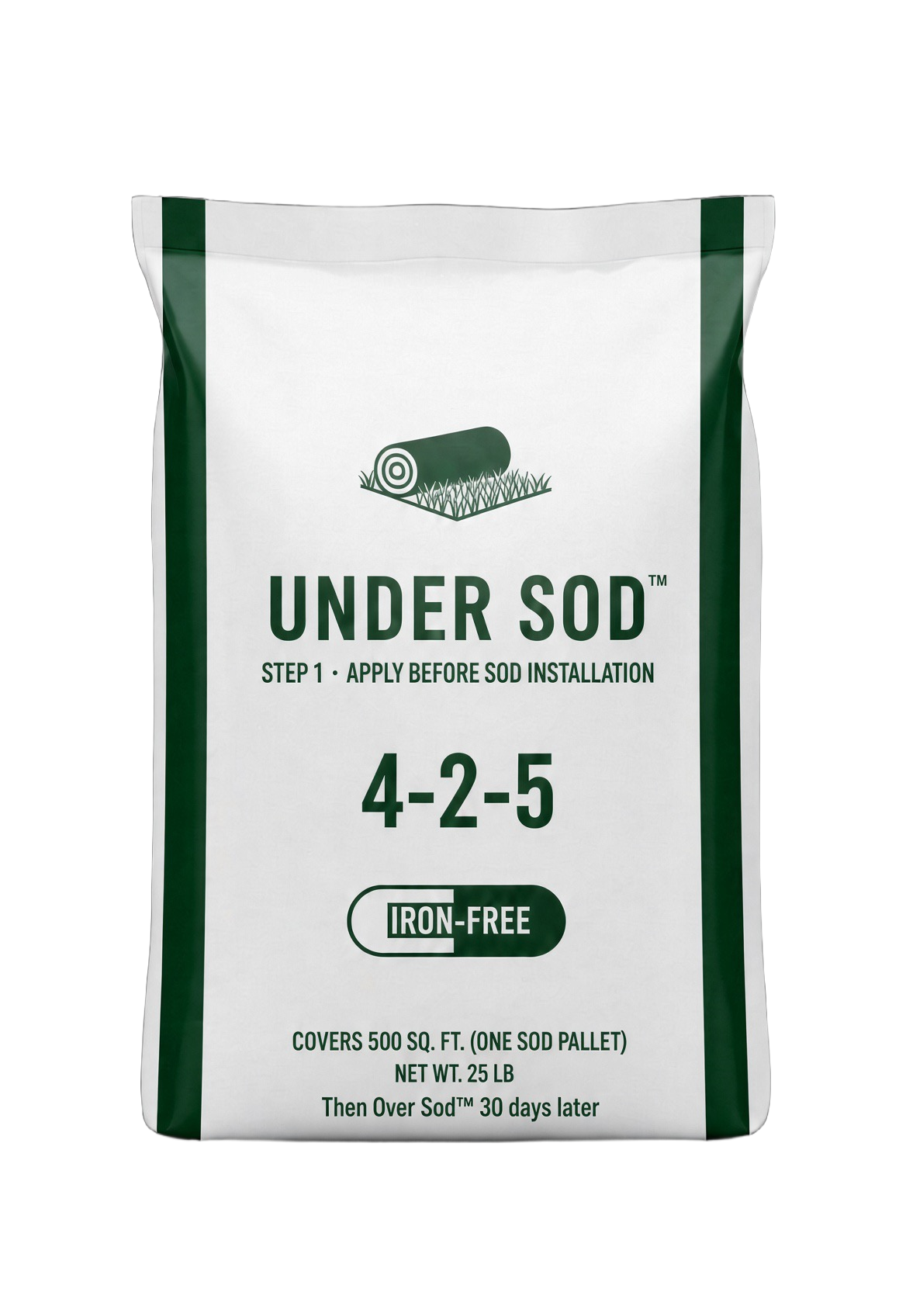
UNDER SOD™ uses a low-phosphorus, K-forward 4-2-5 for a specific reason: to supply gentle, slow-release nutrition that feeds the sod as it roots — including a deliberately low dose of phosphorus, enough to support root-zone energy metabolism — without saturating the soil with the high phosphorus levels that shut down the mycorrhizal partnership the rest of the formula is meant to establish. The raised potassium (5%) supports drought, cold, and transplant-stress tolerance through the shock window, and the moderate, slow-release nutrition also avoids burning the tender new roots that are just beginning to regrow.
The numbers are lower because the strategy is different, not because the product is doing less. The plan is: feed modestly, and let the biology multiply the effective reach of that moderate nutrient load. A fine-to-medium granule size (SGN 90) helps the product spread evenly through the prepared topsoil rather than leaving large particles that create hot spots. See the full UNDER SOD™ product specs for the formulation.
But doesn't UNDER SOD™ contain phosphorus too?
This is the fair objection, and it deserves a straight answer: yes, even a low-phosphorus 4-2-5 still contains some phosphorus — so how do we know it won't suppress the very mycorrhizae it's adding?
Two honest points. First, the suppression research is about high available soil phosphorus — the regimes created by concentrated high-P starters and by soils already rich in P. With the phosphorus halved to 2%, UNDER SOD™ now delivers only about 0.5 lb of phosphate (P₂O₅) per 500 sq ft pallet — on the order of 1 lb per 1,000 sq ft, a small fraction of what a conventional high-P starter program applies — incorporated once, at establishment. The intent is to sit in a deliberately low range that still supplies phosphorus for root energy metabolism while staying well clear of the high-P levels shown to strongly suppress colonization.
Second — and this is the part most marketing would skip — the exact applied-phosphorus dose at which suppression begins is not cleanly defined in the literature. The suppression studies measure soil-test phosphorus concentration, not bag application rate, and the relationship between the two depends on a given soil's existing phosphorus and its fixation capacity. So the 4-2-5's 2% phosphorus is best understood as a deliberately low, reasoned dose — well clear of the high-P regimes the research flags, while still supplying establishment phosphorus — not a precisely proven "non-suppressive" number. This is exactly why a soil test matters: on soils already high in phosphorus, even this low dose may be unnecessary, and you should follow the test and your local rules.
Part 6: The Biological Components — What the Research Actually Shows
UNDER SOD™ pairs the low-phosphorus, K-forward 4-2-5 base with a biological package: named endomycorrhizae, a *Bacillus* PGPR consortium, *Trichoderma*, *Ascophyllum nodosum* seaweed extract, and humic and fulvic acid. The three with the deepest turf-specific research — the mycorrhizal inoculant, seaweed extract, and humic acid — are examined below, with an honest account of where the evidence is mixed.
Mycorrhizal inoculant — and the honest case for it
The case for adding mycorrhizal fungi (rather than relying on what's already in the soil) rests on a specific, well-documented point: inoculation helps most where native mycorrhizal populations are low or disrupted — disturbed soils.
- Mycorrhizal inoculants have been most clearly effective in promoting plant growth on severely disturbed or "cut" sites — places where surface soil has been removed and plants are growing in subsoil — and on degraded ground like mine spoils (UC ANR, Topics in Subtropics).
- Infectivity and diversity of AM fungal communities is often reduced in disturbed habitats, which is exactly why adding fungal propagules is recommended to support plant establishment at such sites — with the benefit being real when the native community is insufficient, and negligible when it's already abundant (PLOS One, 2017).
- Inoculation success depends on species compatibility, the soil's carrying capacity, and timing/priority effects — getting the inoculant established before competing communities lock in (Verbruggen et al., 2013, New Phytologist).
A new sod installation is, in mycorrhizal terms, a disturbed site: the lawn area is typically stripped, graded, and rebuilt with loosened or imported topsoil, all of which reduce native fungal inoculum and break up existing hyphal networks. Introducing inoculant at the soil-sod interface, before installation, places it where new roots will form, at the moment native populations are lowest and before a high-phosphorus application would suppress colonization. That is the most defensible window for inoculation that the literature describes.
One more honest point
Sod is not a seedling. It arrives as a mature plant, and the mycorrhizal-establishment case is best documented for seeded plantings, not transplanted turf. The reason it still applies here is the soil, not the plant: when sod is harvested its deeper roots are cut away, and it has to colonize new, disturbed, low-inoculum soil — a genuine fresh-colonization opportunity at the interface — even though the remaining roots may carry some colonization from the farm. Sod sits between a seedling and an established lawn, and the inoculation logic holds precisely because the root zone it's growing into is freshly disturbed.
The honest caveats — stated plainly:
- Product viability varies. Commercial mycorrhizal products are inconsistent; one widely cited survey found that more than half of consumer inoculants tested were not viable (UC ANR). Sourcing live, viable inoculant matters more than the percentage on the bag.
- Inoculating an established lawn does little. There's no good evidence that adding mycorrhizae to already-established turf or trees boosts them (UC ANR). This is precisely why the right time is under new sod, not sprinkled on a finished lawn.
- Inoculant doesn't replace nutrition. "Inoculate and skip fertilizer" is a myth (UC ANR). The symbiosis supplements the plant; it doesn't feed it. That's part of why the formula pairs biology with moderate nutrition.
- Field responses vary. In soils that already hold robust native AM communities, the added benefit may be small. The strongest case is disturbed, rebuilt root zones — which new sod installs usually are.
This is a genuinely supportable position: the right inoculant, in the right place (the disturbed establishment zone), at the right time (before sod and before high-P lockout), is where mycorrhizal inoculation has its best evidence. It is not a miracle, and we don't present it as one.
Seaweed extract (Ascophyllum nodosum) — biostimulant support during transplant
Extract of the cold-water brown alga Ascophyllum nodosum is one of the most studied plant biostimulants. It contains natural plant-hormone-like compounds (including cytokinins and auxins) and other bioactive constituents, and the relevant point for new sod is its documented effect on rooting and stress tolerance — which matters because transplant is when the plant is most stressed.
The most directly applicable work is on turf. Virginia Tech studies of Ascophyllum nodosum extract and humic acid on tall fescue, Kentucky bluegrass, and creeping bentgrass — the exact species used in cool-season sod — found improved leaf water status and improved shoot and root development under drought, reduced disease incidence, and elevated antioxidant levels (Zhang & Schmidt, Virginia Tech). More broadly, Ascophyllum nodosum extract has repeatedly been shown to improve drought and abiotic-stress tolerance across crop species, acting partly through hormone and antioxidant pathways (Frontiers in Plant Science, 2017).
Honest framing
Much of the turf research applied seaweed extract as a foliar treatment, not soil-incorporated under sod, and responses vary with dose, timing, and conditions. The evidence supports the component's bioactivity on these grasses; UNDER SOD™ applies it at the root interface during establishment as a rational extension of that work, to help buffer the transplant-stress window.
Humic acid — soil chemistry plus a direct root effect
Humic substances (humic acid, fulvic acid, and related compounds) are the stable organic fraction of healthy soil, and they do two useful things at once for a new root zone.
Soil chemistry. Humic substances contribute to cation exchange capacity — the soil's ability to hold nutrients in plant-available form — and they chelate micronutrients (keeping iron, manganese, zinc and others accessible) and improve water retention. These functions matter most in sandy, disturbed, or low-organic-matter soils, which is exactly the kind of root zone new sod is often laid on after construction or grading.
A direct root effect. Beyond soil chemistry, humic acid acts as a biostimulant on the plant itself. Multiple studies show humic substances stimulate root development through auxin- and cytokinin-like activity, promoting root elongation, lateral root formation, and root-hair proliferation — which expands the absorptive root surface and improves water and nutrient uptake (humic acid auxin/cytokinin study, AoB PLANTS 2024; ACS Omega review, 2025; Nardi/Canellas review). In the Virginia Tech turf work above, humic acid specifically improved root and shoot development in tall fescue, Kentucky bluegrass, and bentgrass under drought.
A practical bonus: humic substances help build the soil chemistry conditions that support biological activity in general — including the conditions mycorrhizal partnerships need to establish — so the humic and mycorrhizal components reinforce each other. More on this in Humic Acid and New Sod Establishment.
The combination — designed from the research, applied at one moment
No single study tests the finished product — a low-phosphorus, K-forward 4-2-5 plus the full biological package, mixed into prepared topsoil under sod — and we won't claim one does. What we can say is that each component is included for a research-supported reason, and that they're designed to work together at the establishment window:
- A low-phosphorus, K-forward 4-2-5 feeds establishment without the high phosphorus that suppresses mycorrhizae, while the raised potassium supports drought, cold, and transplant-stress tolerance through the shock window.
- Named endomycorrhizae (*Rhizophagus irregularis*, *Funneliformis mosseae*, *Glomus aggregatum*, *Glomus etunicatum*) are placed where the inoculant has its best evidence: a disturbed root zone, at establishment, before high-P lockout.
- **A *Bacillus* PGPR consortium** (*B. amyloliquefaciens*, *B. megaterium*, *B. subtilis*) **and *Trichoderma*** (*T. harzianum / T. virens*) colonize the establishing root zone, supported by a microbial carbon food source.
- Humic acid (with fulvic acid) builds the soil chemistry the root zone (and the symbiosis) needs, and directly stimulates root development.
- Seaweed extract buffers the transplant-stress window when the plant is most vulnerable.
- Iron-free by design — UNDER SOD™ roots the sod; it doesn't green the bag. Greening is a cosmetic the buyer can add later; rooting is the irreversible first-30-days decision.
That's the rationale. The honest limits in each subsection above are part of it. We connect the three biologicals in Mycorrhizae, Humic Acid & Seaweed: The Biological Trinity.
Part 7: Why Timing and Placement Are Not Optional
The components only do their job if they're in the right place at the right time.
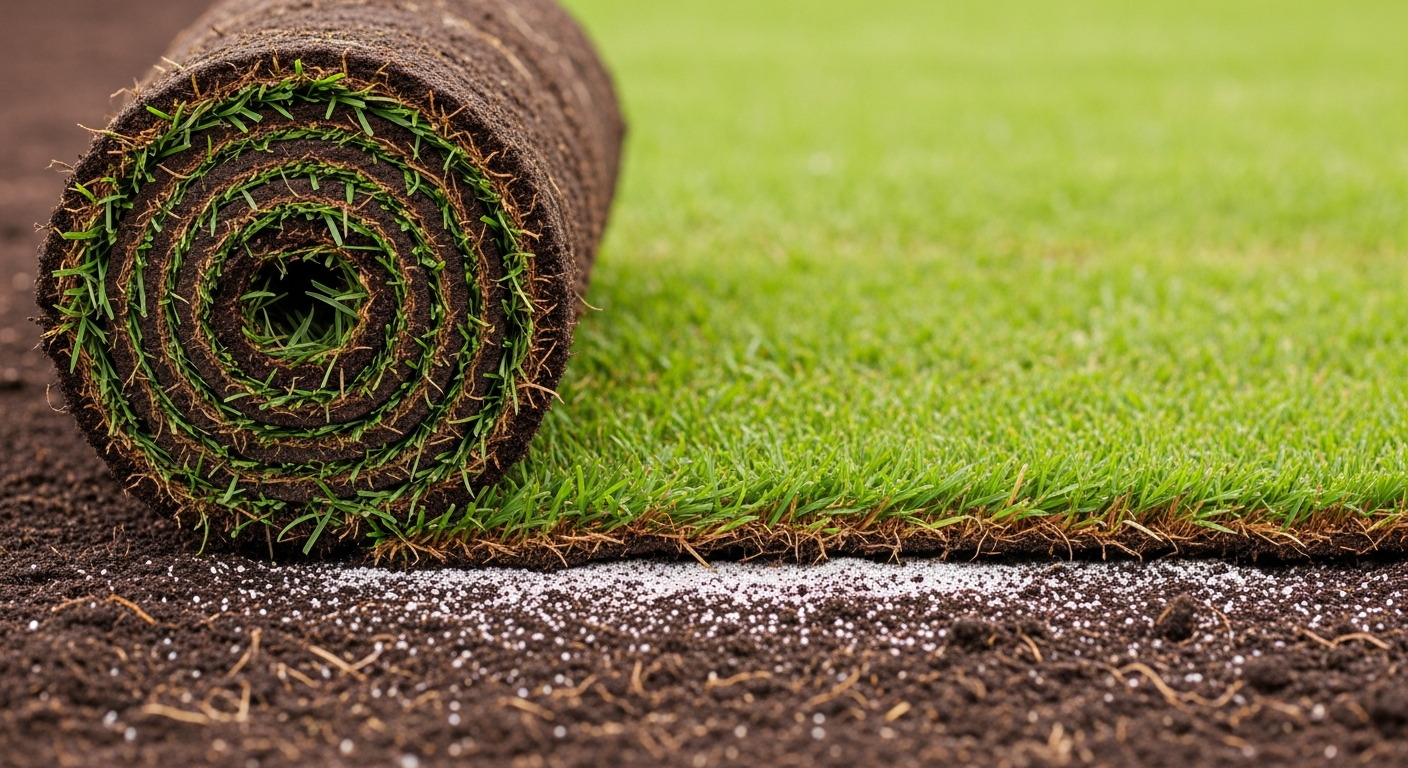
Under Sod is mixed into the top 4 inches of prepared topsoil before the sod goes down, up to 6 where the topsoil lift is deeper. One 25-pound bag covers 500 square feet, which is one standard pallet of sod: one bag per pallet, no measuring. It is applied once. It is not a surface starter, it is not raked into the top inch, and it is not reapplied after installation.
The canonical rule
UNDER SOD™ goes on prepared soil before the sod is laid — never top-dressed onto new sod afterward.
Part 8: The Regulatory Reality — and Why It Lines Up
Here's a detail that turns out to reinforce the whole approach: in many states, you're not allowed to broadcast phosphorus on a finished lawn anyway — but you are allowed to use it when establishing one.
A growing number of states restrict phosphorus on established turf for water-quality reasons (phosphorus runoff drives algae blooms and eutrophication). Connecticut, New Jersey, New York, and others prohibit phosphate fertilizer on established lawns — but every one of these laws carves out the same exception: establishing a new lawn from seed or sod. Connecticut's statute names "establishing new grass or repairing such lawn with seed or sod" explicitly (Conn. Gen. Stat. § 22-111yy), and the University of Connecticut confirms that phosphorus is appropriately applied when sodding a new lawn because it supports root establishment (UConn Soil Nutrient Analysis Lab). New Jersey's law works the same way (Jersey-Friendly Yards).
So the agronomy and the law point to the same window. A moderate phosphorus application, incorporated into the root zone at establishment, is both the biologically sound move (enough P for root energy, not so much that it suppresses mycorrhizae) and the legally appropriate one (the establishment exception). Maintenance phosphorus on a finished lawn is neither. Always apply within your state's seasonal window, keep back from water bodies, and follow a soil test where one is warranted.
Part 9: How to Use UNDER SOD™
One 25 lb bag covers one 500 sq ft pallet of sod. One bag, one pallet — no measuring or spreader math.
Applying UNDER SOD™
- Prep the soil. Clear debris, loosen compaction, rake to a smooth final grade.
- Spread one bag per pallet evenly across the prepared soil.
- Mix it into the top 4 inches of prepared topsoil with a tiller, harrow, or power rake, up to 6 where the topsoil lift is deeper.
- Lay the sod immediately, tight with staggered seams, and roll for good soil-to-sod contact.
- Water thoroughly — about 1 inch the first day, then keep consistently moist for 2–3 weeks.
UNDER SOD™ is made for both cool-season sod (Kentucky bluegrass, tall fescue, RTF, ryegrass, blends) and warm-season sod (bermudagrass, zoysiagrass, St. Augustinegrass, bahiagrass). For centipedegrass, bahiagrass, sandy soils, or phosphorus-sensitive sites, follow a soil test and local fertilizer rules.
Part 10: What UNDER SOD™ Is Not (The Honest Limits)
A science-based product deserves a science-based account of its limits:
- It is not a substitute for soil prep or topsoil. A real, loosened topsoil layer and a smooth grade do most of the work. Under Sod improves a well-prepared root zone; it can't rescue compacted subsoil or thin fill.
- It is not a substitute for water. Transplant survival is driven first by moisture during establishment. No biology changes that.
- Biostimulant responses vary. Seaweed, humic, and mycorrhizal responses depend on soil, conditions, dose, and the quality of the inputs. The research supports the components' bioactivity; it does not guarantee a fixed outcome on every site.
- Native-rich soils may see smaller mycorrhizal benefit. The strongest case for inoculation is disturbed, rebuilt root zones — which most new installs are, but not all.
- It makes no health or safety claims beyond following label directions, a soil test, and local fertilizer ordinances.
We'd rather state these plainly than have a reader discover them. Doing the fundamentals — prep, contact, water — and then giving the root zone research-backed support at the one moment you can reach it: that's the whole proposition.
Frequently Asked Questions
What should I put under new sod?+
A well-prepared topsoil layer is the foundation. To support root establishment specifically, a moderate-phosphorus starter incorporated into the top few inches of prepared soil before laying sod is the research-supported approach — enough phosphorus for root energy without the high levels that suppress beneficial mycorrhizal fungi. UNDER SOD™ is formulated for exactly this.
Why not just use a regular high-phosphorus starter fertilizer?+
High available soil phosphorus is well documented to suppress arbuscular mycorrhizal colonization, because plants stop investing carbon in fungal partners when they can take up phosphorus directly. New sod benefits from forming those partnerships as it rebuilds roots, so a high-P starter can work against long-term root self-sufficiency even as the grass establishes.
Do mycorrhizae actually help new sod?+
The strongest evidence for mycorrhizal inoculation is on disturbed, low-inoculum soils at establishment — which is what a graded, rebuilt sod bed is. Inoculating an already-established lawn shows little benefit, and product viability varies, so timing (under new sod) and a viable inoculant matter. Used that way, the case is sound; it is a support for establishment, not a guarantee.
Is a 4-2-5 too weak for new sod?+
No — it's a different strategy, not a weaker one. The phosphorus is deliberately low (2%) to stay clear of the levels that suppress mycorrhizae, the potassium is raised (5%) for drought, cold, and transplant-stress tolerance, and the slow-release nitrogen feeds establishment without burning new roots — while the biological components extend the effective reach of that modest nutrient load.
Does seaweed extract or humic acid really do anything?+
On the turf species used in sod, Ascophyllum nodosum extract and humic acid have been shown to improve root and shoot development, water status, and stress tolerance. Responses vary with conditions, and much of the turf data is from foliar trials; UNDER SOD™ applies these at the root interface during establishment.
When and how do I apply it?+
Under Sod is mixed into the top 4 inches of prepared topsoil before the sod goes down, up to 6 where the topsoil lift is deeper. One 25-pound bag covers 500 square feet, which is one standard pallet of sod: one bag per pallet, no measuring. It is applied once and is not reapplied after installation.
Is it legal where phosphorus is restricted?+
Yes. States that restrict phosphorus on established lawns specifically allow it for establishing a new lawn from seed or sod. Apply within your state's seasonal window and away from water bodies, and follow a soil test where warranted.
Does new sod even need fertilizer?+
Not on top, not right away — a new sod lawn already carries nutrients from the farm, and university guidance is to wait 30–60 days before feeding the planted grass. What benefits a new install is root-zone preparation underneath before laying: the soil the roots have to grow into. That's a different job than a maintenance feed, and it's the job UNDER SOD™ is built for.
What's the best starter fertilizer for new sod?+
The research-supported approach is a moderate-phosphorus starter incorporated into prepared soil before the sod is laid — enough phosphorus for root energy without the high levels that suppress mycorrhizae — ideally paired with biological inputs (mycorrhizal inoculant, humic acid, seaweed) placed at the soil-sod interface. The common recommendation is a conventional high-phosphorus starter broadcast on top, but that optimizes for fast top-growth rather than root-zone biology.
How is this different from just adding compost or topsoil?+
Quality topsoil and compost build the physical and organic foundation, and you should still use them — UNDER SOD™ is not a replacement for that bulk. It's a targeted starter placed at the root interface, combining moderate nutrition with specific biological inputs at the one window where they have the most leverage. Use good soil and prepare its biology; they're complementary, not competing.
Glossary
- Arbuscular mycorrhizal (AM) fungi — soil fungi that colonize plant roots and extend hyphae into the soil, trading phosphorus and water for plant carbon. About 80% of land plants, including turfgrasses, form this symbiosis.
- Hyphae — microscopic fungal filaments, much thinner than roots, that explore soil pores and volumes roots can't reach.
- Propagule — a viable unit of fungal inoculum (spore or hyphal fragment) capable of starting colonization.
- Priority effect — the advantage an organism gains by establishing first; relevant to placing inoculant before competing communities take hold.
- Biostimulant — a substance that supports plant growth or stress tolerance through means other than supplying nutrients (e.g., hormone-like activity), such as seaweed extract or humic acid.
- Cation exchange capacity (CEC) — the soil's ability to hold positively charged nutrients in plant-available form; organic matter and humic substances increase it.
- Humic substances — the stable organic fraction of soil (humic acid, fulvic acid, and related compounds) that improves soil chemistry and can directly stimulate root growth.
- SGN (Size Guide Number) — a measure of fertilizer granule size; SGN 90 is a fine-to-medium granule that spreads evenly and contacts the soil surface.
- Depletion zone — the volume of soil immediately around a root from which nutrients have already been drawn down; mycorrhizal hyphae reach beyond it.
References
- Breuillin-Sessoms F. et al. (2013). High phosphate reduces host ability to develop arbuscular mycorrhizal symbiosis. PMC
- Nouri E. et al. (2014). Phosphorus and nitrogen regulate arbuscular mycorrhizal symbiosis in Petunia hybrida. PMC
- Contrasting arbuscular mycorrhizal communities along a soil phosphorus gradient (2013). PMC
- Carbon investment into mobilization of phosphorus by arbuscular mycorrhiza (2020). Biology and Fertility of Soils, Springer
- Verbruggen E. et al. (2013). Mycorrhizal fungal establishment in agricultural soils: factors determining inoculation success. New Phytologist
- Inoculation effects on root-colonizing AM fungal communities (2017). PLOS One
- Establishment and effectiveness of inoculated AMF in agricultural soils (2015). PubMed
- Mycorrhizal Inoculants. UC ANR, Topics in Subtropics
- Zhang X. & Schmidt R.E. Influence of plant growth regulators (Ascophyllum nodosum extract and humic acid) on turfgrass growth, antioxidant status, and drought tolerance. Virginia Tech
- Ascophyllum nodosum extract alleviates drought stress in Arabidopsis (2017). Frontiers in Plant Science
- Humic acid improves growth by modulating auxin and cytokinin pathways (2024). AoB PLANTS
- Natural biostimulants: mechanisms of humic substances for plant growth (2025). ACS Omega
- Humic substances biological activity at the plant–soil interface. PMC
- UF/IFAS. Homeowner Best Management Practices for the Home Lawn (EP236). UF/IFAS EDIS
- Rutgers NJAES. Sodding: Steps to an Instant Lawn (FS104). Rutgers NJAES
- Conn. Gen. Stat. § 22-111yy (phosphorus law, establishment exception). Justia
- UConn Soil Nutrient Analysis Lab. Your Lawn and the Phosphorus Law. UConn
- CT Sod. How New Sod Roots: Complete 12-Month Timeline. CT Sod